John Murphy’s apartment fire
The Mystery of The Invisible DogJohn Murphy’s apartment fire is both a rescue emergency and a deliberately manufactured alibi. The blaze draws Jupiter Jones, Pete Crenshaw, Bob Andrews, and Sonny Elmquist into a smoke-filled apartment to save Murphy; later, Jupiter explains that Murphy himself set the fire so he could be taken to hospital and move about under reduced scrutiny. What first appears to be an accident therefore becomes evidence of a calculated deception.
Background and Apparent Cause
The fire erupts while the group is in Fenton Prentice’s apartment. A crash of breaking glass cuts through the closed balcony door, followed by cries that there is a fire. The group rushes out. At courtyard level, flames are burning on the curtains in Murphy’s windows, and Sonny Elmquist is smashing through the glass with an iron pool chair. The suddenness of the alarm and the visible blaze make the emergency immediate; there is no time for the investigators to work out its cause before trying to contain it.
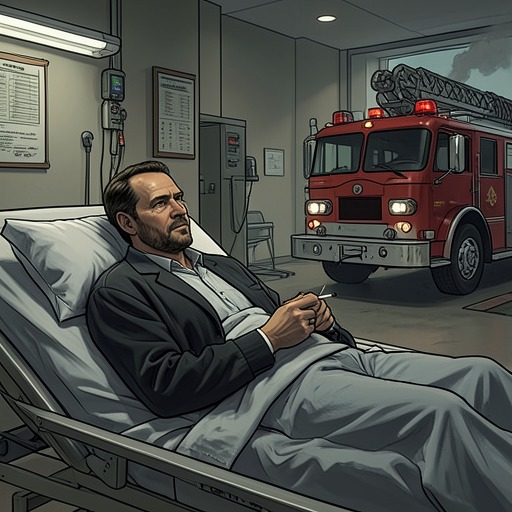
A fire captain later offers a familiar explanation: a lit cigarette fell into the sofa, smouldered, and ignited it, after which the curtains caught fire. He holds up a half-burned cigarette, wet with extinguisher foam, as he gives this account. The captain also stresses how narrowly the apartment escaped a much larger blaze: the Christmas tree was real, and, had the flames reached it, the whole place might have caught quickly. That ordinary explanation initially gives the fire a simple chain of cause and effect, but Jupiter notices that it does not fit what he knows about Murphy.
Rescue and Extinguishing the Fire
As soon as the others reach the courtyard, Pete Crenshaw grabs a second chair and joins the effort at the window. Jupiter Jones spots a fire extinguisher in a niche beside the stairway and runs it to the blaze. Its spray smothers the burning curtains; Jupiter also aims it at a smouldering sofa and the Christmas tree beyond it. The danger is not limited to the curtains, and his extra bursts of foam address the nearby points from which the fire might continue spreading.
The rescue then turns from fighting the flames to finding Murphy. Smoke fills the apartment, and the boys choke as they call out without getting an answer. Jupiter and Pete crouch low to avoid the worst fumes and crawl forward. They find Murphy collapsed in the doorway between the living room and bedroom. Pete turns him over, takes hold of an arm, and slaps his face, but Murphy does not stir. Sonny reaches the door and unlocks it, allowing the investigators to haul the unconscious man toward the light and fresh air.
Murphy is heavy and unresponsive as they drag him out. The boys get him beside the pool, where he lies stretched out in the sun with a pale face. His condition makes the rescue’s stakes plain: the fire has not merely damaged curtains and furniture; smoke has overcome the man inside. Murphy later speaks weakly of sending for his nephew, and an ambulance carries him away. Sonny, still barefoot and very pale, receives credit from the fire captain for noticing the blaze in time; the captain says the person living there might otherwise have been killed.
Suspicion and the Reversal
The apparent accident is questioned before the later explanation is given. When the ambulance is said to be going to Central Hospital, Jupiter asks why Murphy is being taken there, since that is where Miss Chalmers is. Told that it is the emergency hospital, he clarifies that the destination is not his point: Murphy was very careful with cigarettes, so a cigarette fire makes no sense to him. The captain’s account may explain how such a fire could spread, but it does not explain why this particular man would have caused one by carelessly smoking.
That discrepancy changes the meaning of the hospital journey. At the end of the investigation, Jupiter identifies the fire itself as Murphy’s work. Murphy wanted an excuse to be in hospital and knew that between Christmas and New Year there would not be many patients. Jupiter’s explanation is that Murphy was not truly injured: after learning the nurses’ routines, he could slip in and out while they were not watching closely because they wanted him to sleep. The fire’s apparent consequence—Murphy’s removal to hospital—was therefore also the purpose of staging it. The claim that he had been overcome by an accidental blaze supplied a plausible reason for his presence there.
Consequences and Narrative Significance
The fire’s consequences divide into two sharply different realities. In the immediate scene, the danger is physical and urgent: burning curtains, a smouldering sofa, a real Christmas tree, thick smoke, and an unconscious man who has to be dragged outside. In the investigators’ later reconstruction, the same emergency is part of Murphy’s plan. The rescue is genuine even though the accident it seems to answer is not; the boys risk themselves to save a man whose apparent misfortune has been arranged to disguise his movements.
The cigarette becomes the hinge between those readings. In the fire captain’s hands, the half-burned cigarette supports a routine explanation. In Jupiter’s reasoning, Murphy’s care with cigarettes makes that explanation suspicious. The detail that first appears to settle the question instead exposes the mismatch that reopens it. Likewise, the hospital is at once the ambulance’s practical destination and the cover Murphy sought. By linking the staged fire, the seasonal lull in hospital patients, and the nurses’ routines, Jupiter turns an alarming episode into a clue about how Murphy maintained his alibi. The fire’s decisive significance lies in that reversal: what looks like a lucky escape from an accident is revealed as a dangerous act designed to conceal deliberate activity.